
When the Star Lanterns Go Up: Khmer New Year and the Two Cultures of Sóc Trăng
Living between two cultures in Sóc Trăng means watching the town transform twice a year. From the quiet shift of Tết to the water-soaked joy of Khmer New Year, here is what seven years in the Mekong Delta reveals about the art of sharing a home.
CULTURE
Hein Lombard
3/10/20264 min read
Same Streets, Different Worlds: Watching the Star Lanterns Go Up in Sóc Trăng
The yellow flowers come down. The star lanterns go up.
It happens in the same shops, on the same streets. The Tết decorations barely have time to gather dust before the next cycle begins. If you live in Sóc Trăng long enough, you start to notice this quiet shift, the town doesn't so much recover from one new year as it turns its face toward the next one. By mid-April, the Khmer community will be deep into Chol Chnam Thmey, the Khmer New Year, and the delta will smell different, sound different, feel different again.
I have lived here since 2018. I have missed both celebrations every single time.
Two New Years, One Province
Most people know Vietnam has Tết. Far fewer know that in Sóc Trăng, a province in the Mekong Delta with one of the largest Khmer populations in Vietnam, a completely separate new year happens roughly six weeks later. Same country. Same province. Same streets. Different calendar, different temples, different everything.
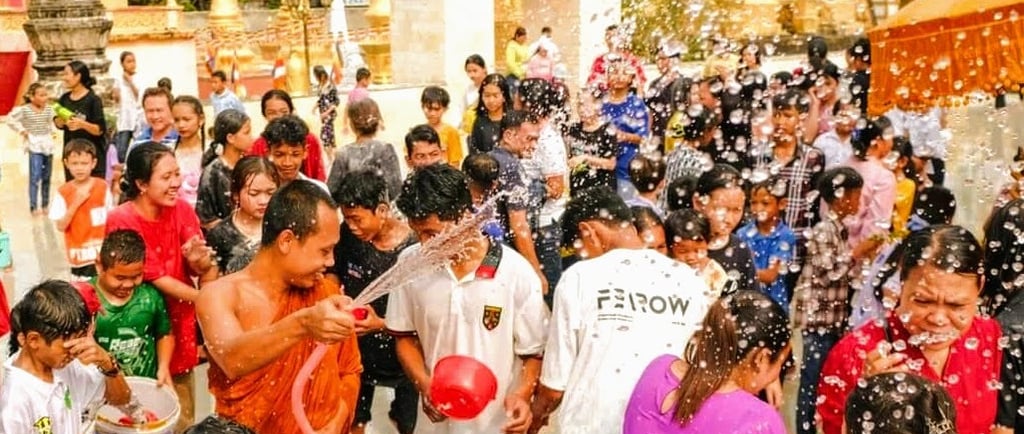
Chol Chnam Thmey falls in mid-April, aligned with the Theravada Buddhist lunar calendar. Where Tết is loud with firecrackers, red envelopes, and kumquat trees heavy with fruit, Khmer New Year is a three-day affair built around temple rituals, water, food offerings, and a kind of communal joy that spills out of the pagodas and into the streets. The water is the part that surprises people. There is a reason it feels related to Songkran in Thailand, all three traditions share the same Theravada roots. By the final day, monks with water guns are completely normal. Nobody stays dry. Nobody seems to mind.
The food preparation starts days before. Women gather under temple shelters to wrap bánh tét, the Khmer version slightly different in shape and filling from the Vietnamese kind, the kind of repetitive, communal work that turns a recipe into a ritual. The chanting fills the pagoda halls. Apsara dancers in gold move through temple courtyards. Monks in orange sit in careful rows. And then the water.
It is three days of something that looks like pure joy from the outside.
What It Looks Like When You're Between
I grew up in South Africa. A country built from more cultures, languages, and histories than most people can name, and more tension between them than most people want to admit. You grow up there learning, even if nobody says it directly, that surfaces don't always tell the whole story. That two groups can share a city, a street, a workplace, and still be living in parallel worlds that only fully reveal themselves at a wedding or a funeral.
I brought that habit of looking twice with me to Sóc Trăng.
What I found was more seamless than I expected. My circle of friends here is mixed, Vietnamese and Khmer, and in some cases I genuinely cannot tell the difference from appearance alone. Darker skin is common across both groups in the delta. Lighter skin too. A good friend of mine is Khmer. If he had never mentioned it, I would not have known. He speaks Vietnamese without distinction, lives in the city, works alongside Vietnamese colleagues, drinks coffee at the same shops.
And yet.
When a Khmer wedding happens in this city, it is unmistakably Khmer. The music is different. The ceremony structure is different. The food is different. The dress is different. When a Khmer family buries someone, the rituals at the temple are rooted in Theravada Buddhism, not the Mahayana practice of their Vietnamese neighbours. These are not small distinctions. These are a people quietly insisting on their own shape, inside a country that officially celebrates their inclusion.
The History Underneath
This is Khmer Krom land.
That is not a political statement, it is a geographical and historical fact. The Mekong Delta was part of the Khmer Empire long before Vietnamese expansion southward brought settlers, then administration, then borders. The Khmer did not leave. They stayed. They are still here, in their hundreds of thousands, in Sóc Trăng, Trà Vinh, Kiên Giang and elsewhere across the delta. Their temples, wat in Khmer, ornate and gold-roofed and utterly distinct from Vietnamese pagodas, sit in the middle of the Vietnamese countryside like quiet, permanent statements.
I came here wired to look for what sits underneath. South Africa does that to you. But seven years in, the most honest thing I can say is that I haven't found a fault line. What I've found is two communities who seem to have genuinely worked out how to share a place, not by becoming the same thing, but by not needing to.
Maybe there's more to it than I can read. My Vietnamese is functional at best, my Khmer nonexistent. But I've stopped assuming the seam must be strained just because it exists.
What I can say is this: the coexistence looks real. It does not look forced or performed. People work together, eat together, build friendships across the line. But the distinctness is also real. Nobody is blending these cultures into something new. The Khmer community here knows exactly who it is. It has its own calendar, its own temples, its own new year, and when that new year comes, the star lanterns go up, the social media fills with Khmer script, and people quietly rearrange their lives to go home.
The View From Outside Both
There is a particular strangeness to living inside two cultures and being fully claimed by neither.
Tết comes, and the city empties. The Vietnamese families go home to their ancestral villages, their reunion tables, their first-morning rituals. I stay. Khmer New Year comes, and the city shifts register again. The Khmer families go home to their villages, their temples, their water fights and banana-leaf parcels. I stay.
I am not complaining. There is something clarifying about being the one who watches. You notice things that people inside the celebration don't need to notice, because they already know them in their bones.
What I notice is that Sóc Trăng is not a melting pot. It is something more interesting than that. It is a place where two distinct peoples have worked out, over generations, how to share a space without dissolving into each other. How much of that arrangement is comfortable, and how much is simply the pragmatic management of an older, unresolved history, that, I genuinely don't know.
Maybe nobody does. Maybe that's the honest answer.
The lanterns go up. The new year comes. The city knows what to do, even when I don't.
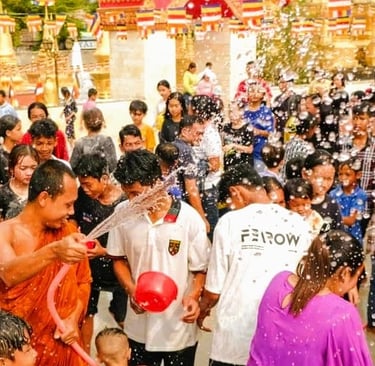
A monk in orange robes sprays a hose at a crowd of smiling people during a water fight at a Khmer pagoda in Sóc Trăng, Vietnam. Water splashes through the air as children and adults celebrate under colorful Buddhist flags.
© 2025. All rights reserved.
hello@gonomadnest.com