
Ok Om Bok Festival in Vietnam: Sóc Trăng’s Biggest Event
A local guide to the Ok Om Bok Festival in Sóc Trăng. Learn about the Ghe Ngo boat races, Khmer traditions, Cốm Dẹp rituals, and tips for enjoying this vibrant event.
CULTURE
Hein Lombard
12/9/20255 min read
Chaos & Calm: A Local's Guide to the Ok Om Bok Festival in Sóc Trăng
My first year in Sóc Trăng, a local friend turned to me in late October and said, "Let's go look at boats."
I pictured something modest—wooden canoes drifting down the river, maybe a few families watching from the shade.
Instead, I walked into a wall of sound that hit me before I even saw the water.
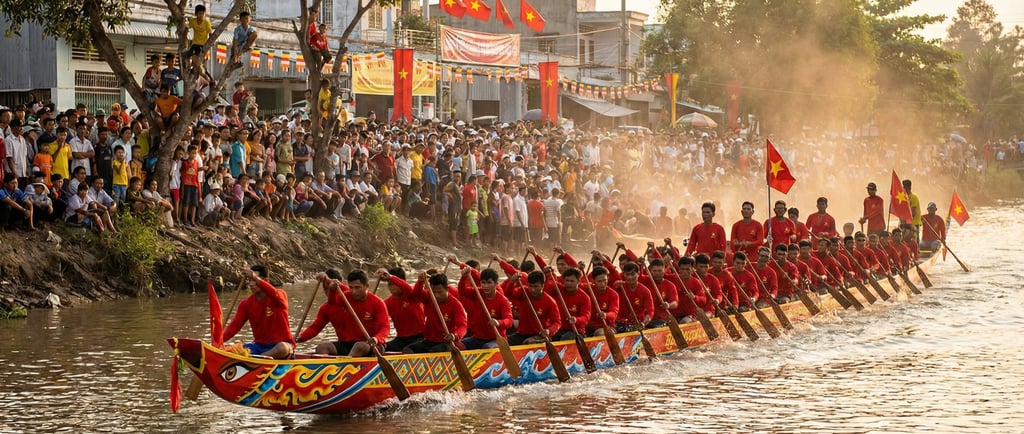
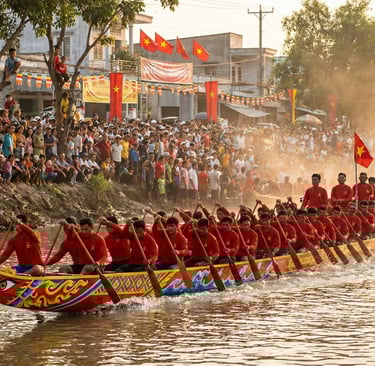
The riverbanks were shoulder-to-shoulder with thousands of people. Teenagers had climbed into trees hanging over the current just to see. On the river itself, 30-meter racing boats—painted electric red, yellow, and blue, their prows shaped like dragon heads—cut through the brown water at speeds that seemed physically impossible. Sixty rowers per boat, all chanting in unison, their paddles hitting the surface in perfect rhythm.
I stood there with my mouth open.
This is Ok Om Bok, the Moon Worshipping Festival.
It's the most intense cultural event in the Mekong Delta, and if you're planning to visit Vietnam in November, here's what you need to know to survive it and actually understand what you're watching.
What Is Ok Om Bok? (And Why It's Not Mid-Autumn Festival)
If you search "Moon Festival Vietnam," you'll mostly find information about Tết Trung Thu, celebrated in August with mooncakes and lantern parades.
Ok Om Bok is completely different.
It's a Khmer festival celebrated primarily in Sóc Trăng and Trà Vinh during the 10th lunar month, usually landing in November. While the Vietnamese tradition centers on harvest folklore and children's celebrations, the Khmer version marks the end of the rainy season—the moment when the floodwaters recede, rice is harvested, and life returns to normal rhythms. It's a spiritual form of thanksgiving. Farmers thank the Moon God for the harvest, watch the water drain back toward the sea, and reconnect with neighbors after months of isolated work in the paddies. It's about survival, abundance, and community.
Key Dates for Travelers
The exact dates shift every year according to the lunar calendar, so planning requires some flexibility.
Main Events:
Event Lunar Date What to Expect The Moon Ceremony 14th night of the 10th lunar month Lanterns, rituals, wind lanterns, water lanterns, and Cốm Dẹp offerings at local pagodas. Quieter, more spiritual. Ghe Ngo Boat Races 15th day of the 10th lunar month The main event. Noon to 5 PM. Maximum intensity.
Local tip: Don't trust generic travel websites for dates—they're often wrong by several days. Check with local hotels or the Sóc Trăng provincial news site about two months before the festival. The lunar calendar doesn't translate neatly to Western dates, and getting this wrong means missing everything.
The Ghe Ngo Boats: Living Nagas
Seeing these boats up close feels surreal. They're absurdly long, narrow, and fast—designed in a way that seems to defy basic boat physics.
To the Khmer community, a Ghe Ngo isn't just a racing vessel. It's a sacred object. It's a living Naga—a spiritual river serpent.
Long before Buddhism spread through the Mekong Delta, the Khmer practiced animism, the belief that everything in nature contains a spirit. Rivers, trees, storms—all alive. A Ghe Ngo carries that same belief. It isn't an object. It has its own soul and must be treated with rituals, respect, and care.
The Eyes of the Beast
Look at the prow and you'll see two painted eyes staring forward.
To the Khmer, these aren't decorative. They're essential. The boat is imagined as a living creature—often a fish or dragon—and it needs eyes to see the path ahead. Without them, the boat is blind and vulnerable.
The eyes must resemble dragon eyes specifically. The dragon is the strongest and most fearless creature in Khmer water mythology. Dragon eyes guide the boat, protect the crew, and frighten away dangerous spirits lurking in the river.
The Mascots (Spiritual Speed)
Each boat belongs to a pagoda and carries a symbolic mascot mounted at the front.
Pích Meng Kol Pagoda: Sparrow, representing agility
Xẻo Me Pagoda: White elephant, representing strength
Tum Núp Pagoda: Dragon, representing dominance
You'll also see tigers, lions, and peacocks. When the boats race, it feels less like a sport and more like a spiritual battle—each guardian pushing its team forward, each crew believing their mascot gives them an edge.
The "Impossible" Physics
Each boat has a flexible tension bar called the Cần Câu running the full length of the hull. It works like a giant spring. When all sixty rowers paddle in perfect synchronization, the entire boat flexes and skims across the water like a skipping stone—bending with the motion instead of fighting it.
The first time I saw it happen, I didn't believe it. The boats don't plow through the water. They bounce across it.
Where to Watch: Mud or Grandstands
The races take place along the Maspero River in the center of Sóc Trăng.
1. The Raw Energy (Riverbanks)
This is where most locals watch, and it's completely free.
The vibe:
Crowded, hot, noisy, and unforgettable. Families sit directly on the muddy riverbank with snacks spread out on plastic sheets. Kids climb trees for a better view. The crowd erupts every time their favorite pagoda surges ahead, and the drumming from the boats is so loud you feel it in your chest.
The downside:
It's packed tight, and pickpocketing happens. Wear your backpack on your front. If you're uncomfortable in crowds or heat, this might not be your spot.
2. The VIP View (Grandstand)
On the opposite bank, there's a concrete grandstand with shade.
The vibe:
Calmer, more organized, with clear sightlines to the entire race course.
What to look for:
Monks in saffron robes. Since each boat belongs to a pagoda, the monks act as spiritual coaches and always get the best seats. Sitting near them gives you a better sense of which boat is which and why the crowd reacts the way it does.
Cốm Dẹp and the "Rubbing the Back" Ritual
Ok Om Bok wouldn't be complete without Cốm Dẹp—a mixture of flattened green sticky rice, banana, and sweet potato. It tastes mildly sweet and earthy, with a chewy texture that sticks to your teeth.
During the Moon Ceremony on the 15th night, elders roll the mixture into small handfuls.
The Ritual
An elder gently feeds a portion to a child while rubbing their back—a gesture called xoa lưng—and asks what they wish for in the coming year. Health. Good grades. A new bicycle. The child's answer is believed to be carried to the Moon God, offering a small window into what the family hopes for.
It's a quiet, intimate moment under the full moon, and if you're invited to a family's Moon Ceremony, consider it a genuine honor.
Practical Tips for Surviving the Festival
Book accommodations early. Hotels in Sóc Trăng fill up fast, sometimes weeks in advance.
Wear sun protection. The races happen at midday with zero shade along the riverbanks. Hat, sunscreen, long sleeves if you burn easily.
Stay aware. Keep your phone and wallet secure. Crowds create opportunities for opportunistic theft.
Hydrate constantly. It gets brutally hot. Bring your own water or buy from vendors, but drink more than you think you need.
Bring earplugs if you're sensitive to noise. The drums are constant and loud enough to make your ears ring.
Final Thoughts
Ok Om Bok isn't just a boat race. It's a direct line into the heart of Khmer culture in Vietnam—spiritual, loud, physical, and completely unpretentious. The Khmer community here doesn't perform this for tourists. They do it for themselves, for their ancestors, and for the Moon God who watched over their harvest.
And when someone asks if you want to go look at boats, say yes. You might walk into one of the most memorable experiences of your life.
© 2025. All rights reserved.
hello@gonomadnest.com