
Rainy Season in Sóc Trăng: What Living Through Wet Season in the Mekong Delta Actually Looks Like
Rainy season in Sóc Trăng isn't what most travel guides describe. A South African expat explains why the city floods, how daily life adapts, and whether visiting Vietnam in wet season is actually worth it.
EXPAT LIFE
Hein Lombard
5/7/20263 min read
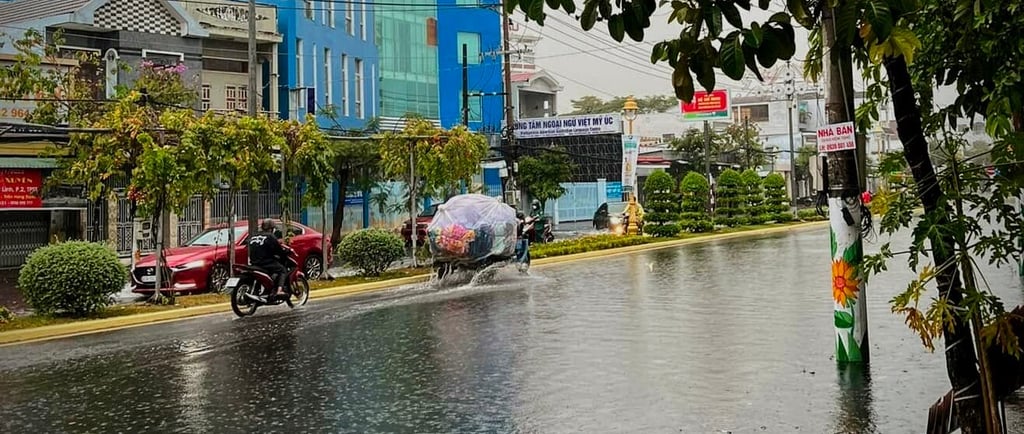
Back home in Knysna, rain is a quiet event. My parents have lived there long enough to read the clouds the day before it arrives, a particular stillness, a certain color on the horizon. When it comes, it's soft and slow, sometimes two or three days of continuous drizzle that soaks gently into the earth. You walk a little faster to the car. You don't rearrange your day around it.
I think about my dad a lot when it rains in Sóc Trăng. He's spent years trying to catch every last drop for his vegetable garden. Here, I watch entire streets turn into rivers in under twenty minutes and think, he'd lose his mind.
This Is Not the Rain You Know
Rainy season in the Mekong Delta operates on its own logic. You can learn to read it, the direction the clouds roll in from, the particular heaviness in the air before it hits, but nothing quite prepares you for the first time you watch a dry street disappear under water while the woman at the bánh mì cart across the road simply pulls a plastic sheet over her ingredients and waits.
It comes fast. It comes hard. And then, usually, it stops.
In the early months of the season, around May and June, a typical downpour lasts fifteen to twenty minutes. Intense, loud, and then done. By the time you reach August and September, the pattern shifts. The duration stretches, the intensity builds, and you stop being surprised when it rains at breakfast, again at lunch, and once more while you're trying to sleep.
The last three days here in Sóc Trăng have followed exactly that pattern. Morning rain. Lunchtime rain. Afternoon rain. A brief reprieve, then back again overnight.
Why Sóc Trăng City Actually Floods
This is the part that took me a few years to properly understand, and it's something most travel guides skip entirely.
Sóc Trăng city has the Maspero River running through its middle. It's a tidal river system, connected to other rivers, which connect to the sea. That means the Maspero has high tide and low tide, and during a full moon, it swells higher than usual.
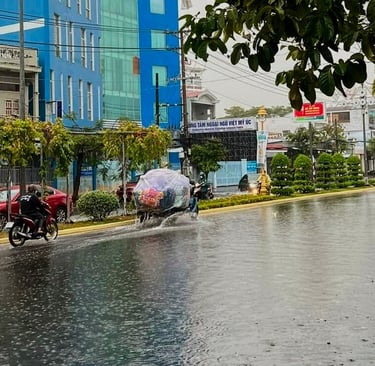
In dry season, that's not a problem. But when a spring high tide coincides with heavy rainfall, the city has nowhere to put the water. The stormwater systems exist, but they drain into a river that's already full. Phu Loi street and the road running past the CoopMart supermarket tend to bear the brunt of it, knee-deep in places, motorbikes pushing slowly through water that has simply run out of anywhere to go.
It's not poor infrastructure. It's geography. The Mekong Delta is flat, river-threaded, and sits just above sea level. When the tide is high and the sky opens up, the water does what water does.
Is It Worth Traveling Vietnam During Rainy Season?
Honestly, yes, with some adjustment in expectations.
The first thing to understand is that rainy season isn't uniform across Vietnam. While the south and Mekong Delta experience their wet season from roughly May through November, the central coast and north operate on a different cycle. If you're planning a trip and want to avoid the worst of it, timing and region matter more than avoiding Vietnam altogether.
The second thing is that rain here rarely ruins a full day. A heavy downpour in Sóc Trăng lasts twenty minutes. You wait it out under an awning with a Vietnamese coffee, the street clears, and you carry on. The locals certainly do.
What rainy season does change is how you dress, how you move, and how you plan. A light rain poncho is more useful than an umbrella. Afternoon plans are loosely held. You learn which streets flood and which don't, and after a while, that local knowledge becomes part of how you navigate the place.
There are also genuine advantages. Rainy season means fewer tourists, lower prices, and a version of Vietnam that feels less performed. The rice fields are impossibly green. The air after a downpour is clean in a way that dry season never quite manages.
What Eight Rainy Seasons Teach You
You stop fighting it somewhere around year three.
The poncho lives on the bike. You check which direction the clouds are moving before a long ride. You know that the market on Phu Loi will flood before the one closer to the center. You've learned which cafes have good drainage and which ones require you to lift your feet.
More than that, you start to find a rhythm in it. The rain punctuates the day. It's a reason to stop, to sit, to watch the street turn briefly into something that looks nothing like a street. And then it drains, and the motorbikes start moving again, and the bánh mì lady folds back her plastic sheet.
Life here doesn't pause for the rain. It just adjusts, briefly, and moves on.
If you're considering a trip to the Mekong Delta during wet season, or you're thinking about what life as an expat here actually looks like beyond the highlights, GoNomadNest covers both. No brochure version.
Phu Loi Street, Soc Trang City
© 2025. All rights reserved.
hello@gonomadnest.com