
Da Lat, Vietnam travel: Why the Mekong Delta's Favourite Escape Is Worth the Bus Ride
Da Lat sits 1,500 metres above the heat of the Mekong Delta. Here's what it actually feels like to arrive by sleeper bus with no plan and stay five days longer than expected.
EXPAT LIFETRAVEL
Hein Lombard
3/31/20264 min read
There's a thing that happens at Vietnamese beaches that takes a while to understand if you grew up somewhere else.
The beach is full. People are dressed beautifully. Parasols are open, selfie sticks are extended, and the photographer of the group is working harder than anyone else there. The water, for the most part, is decorative.
It took me a few years living in the Mekong Delta to stop finding this strange. Vietnamese beach culture isn't about swimming. It's about showing up, looking good, and documenting the fact that you were there. There's something honest about that, actually. At least nobody's pretending the sea is the point.
The point, if you ask most people from Sóc Trăng, is Da Lat.
Da Lat Is Where the Delta Goes on Holiday
Ask anyone from the Mekong where they want to go when they get time off, and Da Lat comes up before you finish the question. It's the default escape. The reward trip. The place parents promise kids and couples plan anniversaries around. For a region that sits at sea level in thirty-five degree heat for most of the year, a city in the Central Highlands at 1,500 metres above sea level isn't just a destination. It's a different atmosphere in the most literal sense.
I didn't go for any of those reasons. I went because a student asked me to.
A Student, a Band 6.5, and a Sleeper Bus
David was 23 when he got his IELTS result. We'd spent months working on his pronunciation, ironing out the gaps in his conversation, getting him ready for university in Canada. When the score came back, he suggested we celebrate by taking a trip together before he left. He'd been wanting to go to Da Lat. I had a five-day break coming at the end of September.
I knew Da Lat only as a name I'd heard. It wasn't on any list. But my brain works better with spur-of-the-moment decisions than with careful planning, and the timing felt right.
We took the Phương Trang bus from Sóc Trăng to Saigon, spent an evening walking around the city, then boarded a sleeper bus north toward the highlands. Most of the journey was through the night. I don't remember exactly when it happened, but somewhere on the road up into the mountains, the air changed. It came in through the gaps in the bus, cooler and thinner, carrying something I hadn't smelled in years. Pine. Damp soil. The particular freshness that lives above a certain altitude.
I grew up in Knysna, on South Africa's Garden Route. What I miss most about it is the spring, that specific crispness in the air when the cold months start lifting. That's what was coming through the window of that bus. Fifteen degrees in the Da Lat morning and a comfortable twenty-four by afternoon. David thought it was cold. I thought it was home.
The Dialect Caught Us Both Off Guard
One thing neither of us expected was how different the local Vietnamese sounded. The Mekong Delta has its own accent, its own rhythm, a southern drawl that becomes familiar fast if you spend enough time there. Da Lat sits in Lâm Đồng province, and the speech patterns are noticeably different. Even David, who'd grown up with southern Vietnamese, said he had to listen more carefully than usual. For me it was just another layer of sound I couldn't decode, but watching a fluent speaker recalibrate was interesting in its own way.
On Booking One Night First
Our first homestay was not what the Booking.com listing described. This is not surprising. I'm an Agoda person by habit, and this was a reminder of why. We'd only booked one night, which made the decision to walk away easy. Losing the cost of a single night didn't sting. We found something better the next morning.
Da Lat has no shortage of accommodation. If you're going somewhere you've never been and you're not sure what you're walking into, book one night. Scout the area when you arrive. Then commit to something that actually suits you. That approach saved the trip from starting badly.
The Selfie Economy of Da Lat
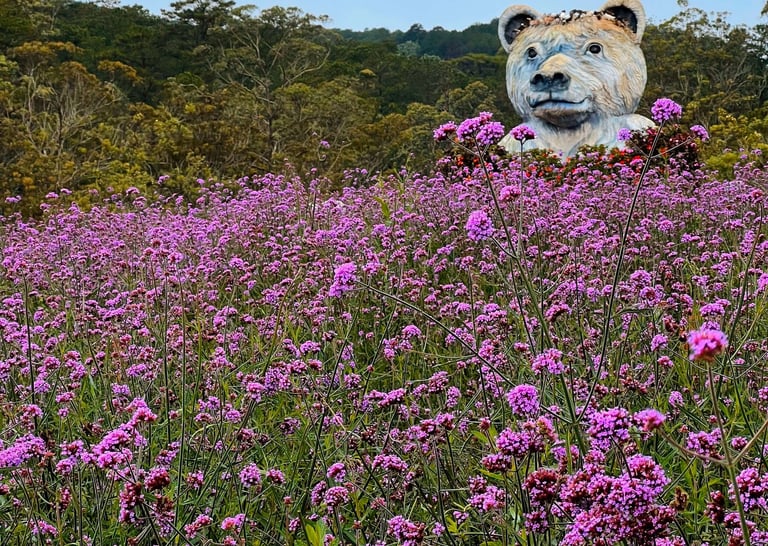
Da Lat has leaned fully into its reputation as a photogenic destination, and the city knows its audience. Flower gardens, strawberry farms, cable cars, valley viewpoints, quirky cafes with moss walls and vintage crockery. Every second venue has been arranged with photography in mind. The young crowd especially comes prepared, outfits planned, lighting considered.
This is not a complaint. There's a warmth to it. Families taking turns in front of the dragon sculpture at the flower park, groups of university students rotating the photographer role, one person always slightly more stressed than the rest because they're the one responsible for getting a good shot.
If you want an easy way into a conversation with strangers, offer to take the photo. Walk up, gesture at the camera, indicate the group. The relief on the designated photographer's face is immediate. You'll get a smile, a thank you, and sometimes a conversation that goes further than either party expected.
What Da Lat Actually Feels Like
There's a version of Da Lat that's been written about extensively. The French colonial architecture, the Valley of Love, the Crazy House, Trúc Lâm monastery. All of it is there and most of it is worth seeing.
But the version I remember is smaller than that. The morning mist sitting in the valleys. The sound of the city before the tourist spots open. David ordering coffee at a pavement stall, both of us slightly underdressed for the temperature, the highland air doing exactly what it promised on the bus ride up.
The Mekong Delta is flat, hot, and river-threaded. It rewards patience and slowness. Da Lat is the opposite of all of that, and somehow that's exactly why people from the delta love it. The escape doesn't have to be far. It just has to feel different.
Five days was not enough. It rarely is.
© 2025. All rights reserved.
hello@gonomadnest.com