
The Foreign Teacher in Southeast Asia — What the Billboard Doesn't Tell You
A foreign Teacher on a billboard brings in business. That's the honest version of why the job exists. Eight years of teaching in Vietnam on what the role actually is and how to navigate it.
EXPAT LIFE
Hein Lombard
6/10/20265 min read

Picture a billboard in the middle of Phnom Penh. A foreign face, probably white, probably smiling in the way that suggests enthusiasm and approachability in equal measure, advertising a summer camp at a local language center. The copy is in Khmer. The face is not.
That image is the honest version of what a foreign teacher represents to a private language center in Southeast Asia. Not the version that appears in the recruitment emails or the Facebook groups where people ask about salary packages and visa support. The version that explains why the job exists in the first place.
A foreign face on a billboard brings in business. Parents who want their children to have an edge, who want them connected to something that other kids in the class don't have access to, will pay for that face. Whether what happens in the classroom behind the billboard is a legitimate learning experience or a token foreign presence occupying a chair is a separate question entirely. The billboard works either way.
Understanding this before you arrive is the single most useful piece of preparation you can do. Not because it should discourage you, but because it removes the illusion that you are there for purely educational reasons and replaces it with something more honest and ultimately more navigable.
The word mercenary gets used in expat circles to describe the foreign teacher's position, and it is not entirely wrong. You are brought in for a specific purpose. You deliver a service. You are, in the technical sense of the word, replaceable.
This should not come as a shock. Every employed person is replaceable. The difference in Southeast Asia is that the replaceable nature of the role is more visible, more openly acknowledged, and more directly tied to factors that have nothing to do with your teaching ability.
I understood this long before I ever stood in front of a classroom. The working world replaces people. Sometimes the reasons are obvious and the replacement is deserved. Sometimes the reasons are structural and the individual is simply the wrong fit for a situation that was never going to work regardless of how well they performed.
In the foreign teacher context, the obvious reasons are depressingly predictable. Alcohol fumes permeating the air around you at eight in the morning. Chronic tardiness. An inability to connect with children, which is a more disqualifying problem than most new teachers expect because the connection is the job. The technical English instruction is secondary to the relationship. A child who trusts you will learn. A child who is slightly afraid of you or simply indifferent to you will sit in your classroom and wait for the hour to end.
The less obvious reasons are harder to prepare for because they are not about you at all.
My stint in Tay Ninh lasted a month. I knew almost immediately that it was not going to work.
This is where I should acknowledge something about how my brain operates, because it is relevant to anyone navigating a similar situation. ADHD, chronic overthinking, and a hypervigilance that reads rooms before anyone has said anything out of place. In environments where I know the cultural terrain, where the social norms are familiar, this combination is exhausting to manage. In an environment where everything is already operating on different frequencies, it becomes a navigation tool whether I want it to be or not.
From the minute I arrived in Tay Ninh I felt uneasy. Not about the town, not about the students, but about the situation itself. The owner wasn't telling me everything. The setup didn't feel legitimate. I couldn't have articulated it precisely at the time but the feeling was accurate.
That instinct is worth trusting. New teachers arriving in Southeast Asia often override it because they have already bought the plane ticket, already told people back home they are doing this, already committed to a version of events that requires the situation to be fine. The sunk cost of the decision drowns out the signal.
If the vibe is off from the moment you arrive, the vibe is off. No amount of settling in will fix a center that is not what it presented itself to be.
Assuming the vibe is right, which it usually is when you have done your homework, the next thing to understand is where you actually sit within the structure of the place.
You are not core staff. Core staff are the people who make all the wheels turn, who have been there since the beginning, who hold the institutional knowledge and the relationships that keep the center functioning. You are an addition. A necessary and valued addition in the right environment, but an addition nonetheless.
My boss will occasionally say something like "my staff will do such and such," and what that phrase communicates, if you are listening carefully, is that there is a group and you are adjacent to it rather than inside it. Early on that distinction was uncomfortable. I saw myself as part of the center in a way that the language did not quite reflect.
Eight years later I read it accurately rather than personally. I am not staff in the way that the Vietnamese teachers who have been there for years are staff. I am also not nothing. There is a third category that exists between those two positions, and it takes years to earn and cannot be explained to someone who has just arrived.
What that third category looks like in practice: birthday gifts exchanged. A holiday once in a while with the whole team. The chief accountant finding me a house when I needed one. A group of colleagues arriving at my door with birds nest after my surgery, which is a traditional Vietnamese gift for someone recovering, and not the kind of gesture you make toward someone you consider disposable.
I am an outsider who has been an outsider in the same place for long enough that the outsider status has become familiar and even comfortable. That is a specific thing. It is not the same as belonging, but it is not nothing either.
The last piece of advice I would give any foreign teacher arriving in Southeast Asia is also the simplest, and the one most likely to be ignored by people who have strong opinions and enjoy company.
Do not spill the tea.
Every center has its internal dynamics. Allegiances, frustrations, histories between colleagues that predate your arrival by years. There will be people you like more than others, because you are human and that is how humans work. There will be situations where someone you trust vents about someone else and seems to be inviting you to take a side.
Stay out of it. Not because you are above it, but because you are the outsider and picking sides in a conflict you do not fully understand, in a cultural context where the rules of engagement are different from anything you grew up with, will not work in your favour. It will work against you in ways that are quiet and slow and very difficult to reverse.
The foreign teacher who arrives with strong opinions about how the center should be run, who allies themselves with one faction of a staff room, who mistakes being liked by some colleagues for being trusted by the institution, tends not to last. Not because they were a bad teacher. Because they misread the room.
Your job is to teach. Your secondary job is to be someone the center is glad to have around. Everything else is not your business unless it directly affects your ability to do those two things.
The billboard is still accurate. A foreign face does bring in business, and understanding that is not cynical, it is just honest. What happens after the billboard is up to you.
If you show up, connect with the kids, stay out of the politics, read the room carefully, and give the situation enough time to develop into something real, the job becomes something more than a mercenary arrangement. It becomes eight years of birthday gifts and birds nest and a five year old correcting your chopstick technique at dinner on a island nobody had heard of yet.
That is not what the recruitment email promised. It is considerably better.
If you are thinking about teaching English in Vietnam specifically, the practical and honest version of what that decision involves is what Go Anyway is for. Particularly if you are past forty and wondering whether the window has closed.
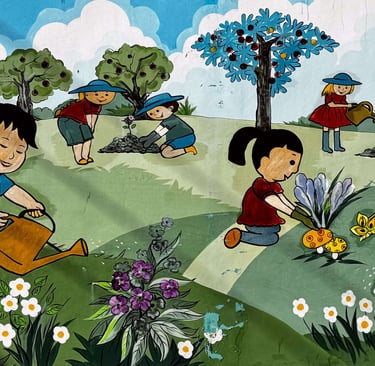
One of thousands of hand painted murals at Vietnamese kindergartens.
© 2025. All rights reserved.
hello@gonomadnest.com