
Renting in Provincial Vietnam - What nobody tells you before you arrive
Seven places in eight years, including a love hotel in Tay Ninh. Here is what renting in provincial Vietnam actually looks like when you live it rather than read about it.
EXPAT LIFE
Hein Lombard
4/14/20265 min read
The bus dropped me somewhere near Tay Ninh and the husband of the center owner picked me up. He drove me to the hotel, helped me with my bags, and left. I looked around the room. There was a particular kind of sofa. There was a heart shaped bathtub. I messaged Robby, my agency handler, and asked him to confirm what kind of establishment I had been booked into. He asked me to send pictures. I sent pictures. There was a brief pause on his end that I chose to interpret as professionalism.
I stayed there for a month. The bathtub was never used. The sofa was occasionally sat on. It was comfortable enough, if you could overlook the general implication of the décor, which after a few days you mostly could.
That was my second placement in Vietnam. I have since lived in seven different places. The heart shaped bathtub remains the most memorable feature of any of them, though not necessarily for reasons that reflect well on my housing trajectory.
If you are coming to teach English in provincial Vietnam and your employer provides accommodation, you are, as I have come to think of it, in the pound seats. The alternative is navigating the rental market in a city where most landlords speak no English, most listings are on Vietnamese Facebook groups, and most negotiations require someone in your corner who understands both the language and the unwritten expectations. Having your employer handle it removes a layer of complexity that is genuinely worth something.
My first placement in Dong Nai came with a three bedroom house, a kitchen large enough to cater a modest wedding, a living room, and a bathroom of reasonable proportions. It was far too large for one person and directly next to the school, which meant my commute was measured in seconds. I lived there alone in a way that felt slightly absurd, rattling around rooms I had no use for, cooking modest meals in a kitchen designed for grander ambitions.
Then came Tay Ninh. Then came the bathtub.
My first place in Sóc Trăng was on the same property as the English center, which solved the accommodation problem efficiently if not especially atmospherically. Then Covid arrived, the center moved to new premises, and the new premises did not come with a flat attached. For the first time I needed to find somewhere myself.
This is where Mr. Binh became relevant.
Mr. Binh works for the government in agricultural animal disease control, which is not the most obvious qualification for housing advice, but one of my students had taken me to the pet shop his wife runs from their home, mostly for ornamental fish of every description including Koi, along with everything conceivably related to fish and shrimp farming. Mr. Binh is one of those people who is simply helpful by nature. We communicate in broken English and have done for years. When I needed somewhere to live he pointed me toward a couple of options, which is how things tend to work here. Not listings. People.
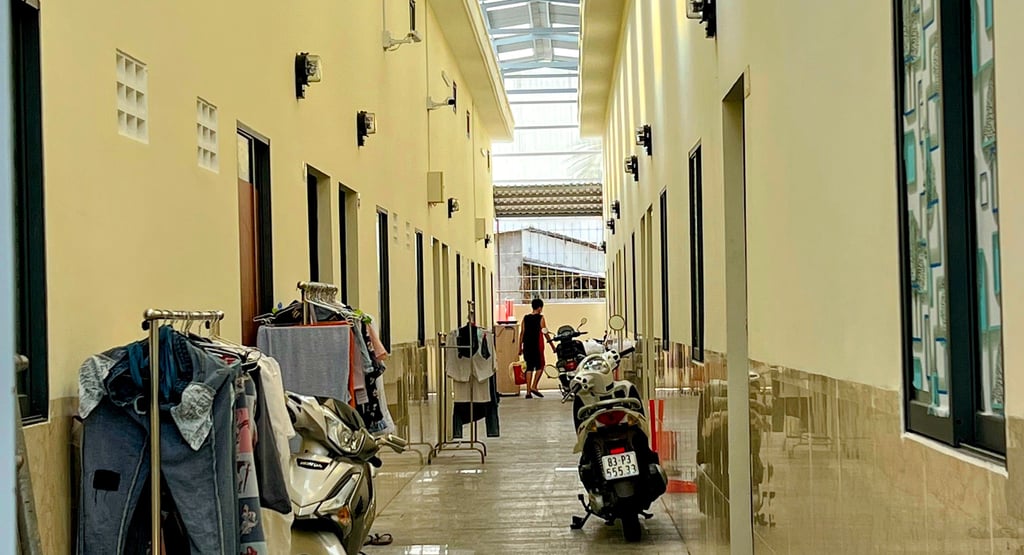
The second option was a boarding house, which in Vietnam means something different from what the word suggests in English. It is not a house where people board. It is two rows of small apartments or large rooms facing each other across a narrow covered alley, self-contained units sharing a common passage. This one was new and clean and perfectly reasonable in most respects. The motorbikes using the alley as a thoroughfare at all hours eventually wore me down. I moved.
This time our chief accountant found me the place, which tells you something about how accommodation works when you have been somewhere long enough to have colleagues who look out for you. It was an actual house in Sang Quang, two bedrooms, a decent kitchen, a small porch with security fencing, 1.4 kilometres from work on my bicycle. Very nice. There was, however, the roof.
A flat metal roof in the Mekong Delta is not a design feature. It is a slow cooker. The house absorbed heat through the day and released it steadily through the evening in a way that made the concept of a cool room theoretical rather than practical. I lived there for about a year before the landlord asked me to move to another house just around the corner, because he wanted to connect his property to the one next door where his mother-in-law lived. I moved without complaint. The new house was the same size and, mercifully, not a flat metal roof oven.
Shortly after that, the landlord who rents us the English center building bought the property next door and fixed up a small apartment in it. One bedroom, a bathroom, a living room and kitchen combined. Two million dong a month. That is where I am now, which makes my commute measurable once again in seconds and means my landlord is also my neighbor, which keeps things efficient if occasionally lacking in professional distance.
What the expat guides written about Hanoi and Ho Chi Minh City tend to gloss over is the bureaucratic layer that comes with renting in provincial Vietnam as a foreign worker.
The rental contract is held in my employer's name, not mine. My work permit is attached to it. When I move, my boss notifies the local police that I have changed address. Every six months my employer fills out a form at the police station. If I travel during holiday periods, my boss is required to file a report on my movements. None of this is onerous in practice, it mostly happens without my direct involvement, but it is worth knowing before you arrive with assumptions shaped by renting a flat in London or Cape Town.
The contract negotiation itself, such as it is, also runs through my employer. My boss checks the terms, handles the landlord conversation, and confirms the arrangements. My contribution to the process is largely ceremonial. This is not a complaint.
After seven places, a few things continue to surprise me every time.
The air conditioners. In Vietnam, tenants routinely uninstall their air conditioning units when they move out and take them to the next place. What they leave behind is a bracket on the wall and a set of pipes going nowhere, a rectangular ghost of the previous tenant's comfort arrangements. Only the boarding house I lived in had units pre-installed. Everywhere else, you either arrive with your own or you buy one. Deposit is typically one month's rent in advance. Nobody mentions the aircon situation in advance.
The cleaning. Or rather, the absence of it. When Vietnamese tenants move out of a property, a thorough clean on the way out does not appear to be standard practice. I have moved into places in a state that suggested the previous occupant left in some haste, or possibly mid-meal. I clean thoroughly when I leave somewhere. I have been told this is unusual. I choose to consider it a personal standard rather than a cultural observation.
The costs, if you are trying to calibrate expectations. The two bedroom houses I lived in around Sóc Trăng city ran to about 4.5 million dong a month, not including electricity. My current one bedroom flat is 2 million. Electricity with air conditioning running at home costs me around 500,000 dong a month. Water is so cheap it barely registers as a line item. These are not Hanoi numbers or Ho Chi Minh City numbers. They are Mekong Delta numbers, which is a distinction worth understanding before you price up a life here based on the wrong city.
Provincial Vietnam is not difficult to rent in, once you accept that the process runs on relationships rather than listings, that your employer will be more involved than feels normal, and that the previous tenant almost certainly took the air conditioner.
Come with your own if you can. Leave the place clean when you go. And if your agency books you into a love hotel, send pictures immediately. Your handler will want documentation.
What a Vietnamese Boarding House Actually Looks Like
© 2025. All rights reserved.
hello@gonomadnest.com