
Hon Son Island Vietnam - What Vietnam Looked Like Before TikTok Found It
Six years ago I went to Hon Son island with twenty colleagues after three months of summer school. The island was undiscovered, the seafood was extraordinary, and a five year old corrected my chopstick technique.
EXPAT LIFETRAVEL
Hein Lombard
4/10/20265 min read
There is a particular kind of tired that comes at the end of the Vietnamese summer school break. It is not the tired of having done nothing. It is the tired of three months of doubled schedules, extra classes stacked onto regular classes, and the specific challenge of teaching children who are present in body but elsewhere entirely in spirit. Their parents have jobs. School is out. A language centre is a reasonable solution to both problems. For the teachers, it is a juggling act that runs from June through August and ends with everyone quietly desperate for two days somewhere that is not a classroom.
Six years ago, our school did what it sometimes does at the end of summer. We went somewhere together.
There were about twenty of us. Six Vietnamese teachers, my boss and her husband and her son, the company director and his family, our chief accountant and her family, and me, the only foreigner in the group, which is how it usually goes on these trips and how I prefer it. We took a coach from Sóc Trăng to Rạch Giá in Kiên Giang Province, then a Super Dong ferry from the terminal out into the Gulf of Thailand. The crossing took about ninety minutes. It was a clear day and we sat on the upper deck with the sun on our faces and the water going from brown river delta to something genuinely blue.
Hon Son appeared the way small islands do, quietly and then all at once.
Back then, Hon Son was not a destination in any meaningful sense. There were homestays but I am not sure there was a hotel yet. Vietnamese tourists had not found it in any numbers. There were certainly no TikTok videos. We were not pioneers exactly, but we were close enough to it that the island felt like something we had stumbled into rather than chosen from a list.
I had done no research before going. I sometimes do that deliberately. Arriving without a frame of reference means the place gets to introduce itself on its own terms.
What it introduced me to first was the seafood.
Here in the Mekong Delta, the default fish is freshwater snakehead. It is cheap, available everywhere, and an acquired taste that I have spent six years acquiring with mixed results. On Hon Son, everything coming out of the water was saltwater, and the difference was immediate. We ate things I could not name, grilled and steamed and served in ways that assumed you already knew what you were doing with them. I did not always know what I was doing with them, but that turned out not to matter.
One evening at dinner, my boss's son, who was five years old at the time and has been my self-appointed companion at every group meal since, watched me handle my chopsticks and lost the ability to speak. The laughing started quietly and then became something he could not stop. When he recovered enough to be useful, he put down his own chopsticks, repositioned mine with the focused authority of someone who has been waiting a long time for this moment, and demonstrated the correct technique. I had always considered my chopstick skills reasonable. A five year old disagreed, and five year olds are rarely wrong about these things.
The island is small enough to cover by motorbike in under an hour. The geography splits itself roughly in two. On one side, a modest stretch of coastline with calm water and the kind of beach that exists for sitting rather than performing. On the other, the terrain shifts into something rougher, large boulders at the water's edge, the sea going deep and dark blue in a way that the Delta never does.
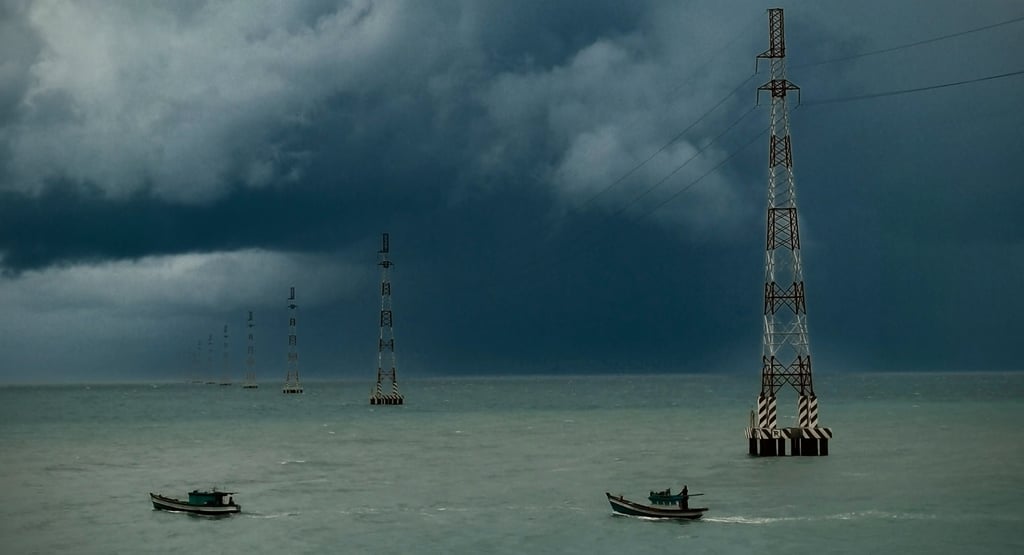
The thing that stopped me was not the beaches or the boulders. It was the electricity pylons.
They march across the water from the mainland to the island in a line, large metal structures standing in the sea, carrying power cables from somewhere connected to somewhere that used to not be. I stood and looked at them for longer than made sense and thought about what they represented. Not just electricity, but the whole chain of change that electricity implies. Roads follow power. Tourists follow roads. Before all of that, Hon Son was whatever it was on its own terms, which is something I can only imagine now and not actually know.
My father used to take our family to places like this along the Transkei coast in South Africa. Undeveloped stretches of coastline where the point was the fishing and the rock pools and the sand dunes and the absence of anything organised. I was less interested in the fishing than my father and brother were. I was more interested in what was around the next headland. I suppose that particular habit never left me.
Standing on Hon Son looking at those pylons, I thought about what the island looked like before they arrived. I still think about it.
Hon Son has been found since then. TikTok had something to do with it, as it tends to. Young Vietnamese travel there now in numbers that would have been unrecognisable six years ago. This is not necessarily a bad thing, and I want to be careful about how I frame it because the foreigner who complains about development in Vietnam is a familiar and not always appealing figure.
I came across a video recently made by a foreign content creator living in Vietnam, complaining about Vingroup and their resort developments and what they do to the Vietnamese countryside. The comments were full of Vietnamese people pushing back, and they were not wrong to. The resorts that foreigners find aesthetically objectionable, the European themed architecture, the large scale hospitality infrastructure, are exactly what millions of Vietnamese and Asian tourists want and enjoy. Vingroup also creates jobs, and the businesses that cluster around tourism infrastructure feed families. The foreigner standing at the edge of a recently discovered place mourning its undiscovered past is not always the most reliable narrator of what development means to the people who actually live there.
What I will say is simpler than all of that. The Hon Son I visited six years ago no longer exists in quite the same form. The one that exists now is probably better resourced, more comfortable, and easier to visit. Whether it still has the particular quality that made those two nights feel like something worth remembering is a question I cannot answer without going back.
I would like to go back.
If you are considering Hon Son, the practical version is straightforward. Coaches run regularly from Sóc Trăng and other Mekong Delta cities to Rạch Giá. The Super Dong ferry terminal in Kiên Giang Province runs services to Hon Son and the nearby Nam Du archipelago. The crossing is around ninety minutes and on a clear day the upper deck is the only place to be. Accommodation has expanded significantly since my visit. Check current options before you go, because what was true six years ago is unlikely to still apply.
Go for the seafood. Go for the boulders on the far side of the island. Go before you read too much about it.
And if a five year old at the dinner table wants to correct your chopstick grip, let them. They are almost certainly right.
© 2025. All rights reserved.
hello@gonomadnest.com