
The Landlords of the Sky: Inside the Secret "Bird Prisons" of the Mekong Delta
Why are there windowless concrete towers all over the Mekong Delta? Discover the secret world of bird nest farming in Sóc Trăng, from the "prison" architecture to the healing "white gold" inside.
CULTUREFOOD
Hein Lombard
2/4/20267 min read


The Landlords of the Sky
I remember the first time I saw them. It was 2017, and I was rattling along on a local bus from Sihanoukville, Cambodia, to Trat in Thailand.
Staring out the window at the passing countryside, my eyes kept snagging on these strange, brutalist structures rising out of the fields. They were tall, narrow, concrete blocks with no windows—just rows of tiny, black ventilation holes. They looked like silent sentinels guarding absolutely nothing.
A French woman sitting next to me was watching them too. We spent the better part of an hour trying to guess what they were. Were they granaries? Some kind of secure storage?
"Maybe... a prison?" she finally whispered, sounding unsure.
We both fell silent. A prison was the only thing that made sense for a building that looked so determined to keep the outside world out. But a prison in the middle of a rice paddy? It didn't quite fit.
The conversation eventually spiraled into ridiculous guesses before fading away, and I filed the image away as just another "Southeast Asia mystery" I’d probably never solve.
Fast forward a few years. I moved to Sóc Trăng, Vietnam, to teach English. On my very first drive out of the city toward the coastal town of Trần Đề, I saw them again. The same gray concrete skin on some, and others looking more modern, but the same windowless walls, and the same fortress-like vibe.
But this time, I noticed something else. They weren't silent.
From the rooftops of these concrete bunkers, loudspeakers were blasting a chaotic mix of chirping, clicking, and high-pitched squeals. And instead of barbed wire designed to keep people in, I saw tiny birds darting into the ventilation shafts.
I realized then that the French woman and I had been dead wrong. These weren't prisons. They were luxury hotels. And the tenants weren't convicts; they were the producers of one of the most expensive ingredients on earth.
The Reality of Bird Nest Farming
So, what exactly are these concrete monoliths?
Locals call them nhà yến (swiftlet houses), but I’ve come to think of them as luxury condos for freeloaders.
Unlike traditional farming where you fence animals in, bird nest farming is an exercise in seduction. You cannot catch a swiftlet and force it to build a nest; if you cage them, they die. Instead, you have to convince them that your concrete box is the coolest, safest, and sexiest cave in the Mekong Delta.
That explains the "prison" architecture that confused me back in 2017. The thick concrete walls and lack of windows aren't designed to keep the birds inside, they are designed to keep the brutal tropical heat out.
Inside, it is a different world. The farmers, or rather, the "landlords", maintain a strict microclimate. They aim for a constant 27°C to 29°C with humidity pumped up to 80%. It is dark, damp, and smells faintly of organic decay. To you and me, it’s a dungeon. To a swiftlet, it’s a five-star resort.
The Soundtrack of Sóc Trăng
But the amenities don't stop at air conditioning. The most distinct feature is the sound system.
If you walk down certain streets in Sóc Trăng, you’ll hear it. It’s a rhythmic, high-pitched chirping loop drifting down from the rooftops.
Now, don't worry, this isn't a scene from an Alfred Hitchcock movie. The birds aren't swooping down to attack, and the sound doesn't follow you everywhere you go. It’s strictly a stationary playlist, broadcast from speakers near the ventilation holes. These are recordings of swiftlet calls, a mix of "come here" signals and happy flock sounds designed to tell passing birds, "Hey, the party is down here!"
It plays from dawn until dusk, but strangely enough, you stop noticing it after a while. Unlike the unpredictable chaos of a neighbor’s karaoke session, the bird sounds are consistent. They eventually just become part of the city’s texture, a background hum of an industry trying to lure "white gold" out of the sky.
The "Feather Soup" Myth
To understand why this is such a strange concept for me, you have to rewind about forty years to a backyard in South Africa.
I was around ten years old when my parents took a trip to Thailand. My dad, always the adventurous eater, came back with stories that fascinated and horrified me. One of them was about people paying a fortune to eat "bird nest soup."
I remember looking out at the trees in our garden. We had plenty of birds, and after a storm, you would often find tiny, fragile nests blown onto the grass. They were messy little things, woven together from dead twigs, mud, dry grass, and plenty of feathers.
My ten-year-old brain did the math and came up with a horrifying result. Why? Why would anyone want to boil a muddy ball of twigs and eat it? It sounded like the kind of punishment you’d get in a fairy tale, not a luxury meal.
It wasn't until I moved to Sóc Trăng that I realized I had the biology completely wrong.
The "landlords" here aren't renting to sparrows or robins. They are farming the Edible-Nest Swiftlet (Aerodramus fuciphagus). Unlike my garden birds in South Africa, these little guys don't use twigs or mud. They are the only birds in the world that build their nests entirely out of their own saliva.
It sounds gross, but in practice, it’s miraculous. The bird weaves a cup shape using strands of spit that harden into a resin-like substance when exposed to air. When harvested and cleaned, it isn't brown or muddy. It is translucent, white, and pure.
The Taste Test: Eating the Noise
Recently, life gave me a very practical reason to test the product myself.
I underwent surgery to remove my gallbladder. In Vietnam, bird nest soup is the gold standard for recovery. It is believed to be rich in Epidermal Growth Factor (EGF), which helps speed up tissue regeneration and healing.
Suddenly, I wasn't just an observer of the industry; I was the target market. Colleagues and friends stopped by with gifts, and I ended up with a perfect "A/B Test" of the market right on my kitchen table.
On one side, I had the famous yellow boxes from Khanh Hoa, the state-owned giant that dominates the national market. It’s the "Coca-Cola" of bird nests, sterile, consistent, and factory-sealed.
On the other side, I had a humble plastic bag containing jars from Yến Sào 5 Hiếu, a local producer right here in Sóc Trăng. This was the real deal: Yến Tươi (fresh bird nest).
Fresh vs. Industrial Bird Nest
I cracked open one of the local jars.
If you are expecting a flavor explosion, you will be disappointed. On its own, bird nest is almost flavorless, it tastes like whatever you cook it with. My jar was brewed with rock sugar and pandan leaves, making it sweet and fragrant.
But the secret is in the texture.
Unlike the industrial versions which can sometimes feel like soft jelly, the fresh Sóc Trăng nest had a distinct "snap" to it. It was gelatinous but firm, with a satisfying crunch that told me it hadn't been processed to death. It felt... alive.
As I sat there sipping the warm, sweet soup, I could hear the faint sound of the bird-call speakers drifting in from the street outside.
For years, that noise had just been a nuisance, a weird quirk of living in the Mekong Delta. But now, it felt different. The noise was the sound of the harvest. The "prison" buildings were the gardens. And this bowl of "white gold" was the result.
Why We Drink the "Thermo Soup"
another side of Soc Trang's food culture
You might wonder why locals pay so much money for solidified bird saliva. It’s not just for the status.
In Traditional Chinese and Vietnamese medicine, bird’s nest is considered a "cooling" food (Yin). Sóc Trăng gets incredibly hot, especially in April and May, and this soup is the ultimate internal air-conditioning. It is believed to boost the immune system, rejuvenate the skin (collagen!), and "cleanse" the lungs of dust and heat.
We call it a "soup," but in the Mekong Delta, it is often served ice-cold as a dessert. Locals usually eat it late at night before bed (to let the nutrients absorb while sleeping) or during the hottest part of the day to cool down.
The Recipe: Sóc Trăng "Cooling Gold" Soup (Tổ Yến Chưng Đường Phèn)
A simple, traditional way to prepare the nest. The key is "Double Boiling", never boil the nest directly in water, or it will dissolve into mush.
The Ingredients:
1 Dried Bird Nest (approx. 10g) – If you are in Sóc Trăng, buy this local!
Rock Sugar (Đường phèn): To taste. Must be rock sugar for that gentle, fresh sweetness.
Dried Red Dates (Jujubes): 4–5 pieces.
Lotus Seeds: A small handful (fresh is best, but dried works if soaked).
Fresh Ginger: 2–3 thin slices. Crucial for neutralizing any "fishy" smell and warming the stomach.
Water: Fresh filtered water.
The Process:
The Soak: Soak the dried nest in a bowl of cool water for about 1–2 hours until it expands and softens. (If there are any tiny feathers left, use tweezers to pick them out—this is the meditative part!). drain the water.
The Prep:
If using dried lotus seeds, boil them separately until soft.
Rinse the red dates.
The Steam (Double Boil):
Place the softened nest, lotus seeds, red dates, and ginger slices into a small ceramic bowl or jar.
Pour in filtered water until it just covers the ingredients.
Place the bowl inside a larger pot of boiling water (bain-marie style) or use a steamer. Cover the pot.
Steam on low heat for 20–30 minutes.
The Sweetener:
Add the rock sugar only in the last 5 minutes of steaming. (Adding it too early can make the nest tough).
The Chill:
Turn off the heat. Let it cool to room temperature.
The Sóc Trăng Way: Put the bowl in the fridge for a few hours. Serve it aggressively cold.
Final Verdict
Sóc Trăng is full of these contradictions. It’s a place where ugly, noisy concrete bunkers produce something delicate and healing. It’s a place where a "prison" is actually a palace. And it’s a place where, if you are lucky (or recovering from surgery), you get to taste the difference between a factory product and the real thing.
So, is the noise annoying? Yes. But would I trade my fresh jar of 5 Hiếu to make it stop?
Not a chance.
Another interesting side of Mekong culture...The Tiger on my door.
A typical swiftlet farming house. Windowless, imposing, and often mistaken for a prison by travelers.
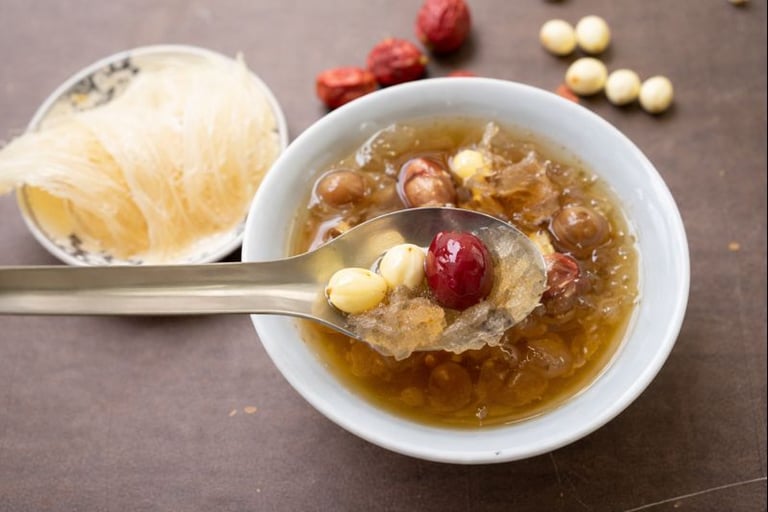
Tổ Yến chưng đường phèn. In Sóc Trăng (and the rest of Vietnam), this isn't just "food", it's medicine.
© 2025. All rights reserved.
hello@gonomadnest.com