
What Tet Teaches Expats About Family (Life in Sóc Trăng)
Tet in Vietnam is about family. But what if you don't have one here? From my students to the security guard, here is how we build a makeshift web that holds.
CULTUREEXPAT LIFE
Hein Lombard
2/14/20265 min read
What Tet Teaches You About Family When You Don't Have One
Tet is coming.
You can feel it building in Sóc Trăng like a tide. The kids in my classes are vibrating with it—counting down the days until they get on the back of their parents' motorbikes and head to their grandparents' villages. The streets are filling with potted kumquat trees and red banners. The Grab drivers are talking about going home.
Tet is the season when Vietnam organizes itself around a single, central truth: Family is the structure that holds you.
And if you don't have that structure? Tet is when you feel the absence most acutely.
The Jungle Gym
I never used to like small kids.
In my early teaching days in Dong Nai, I was terrified of them. I was stiff, serious, and constantly worried about losing control. I didn’t trust the chaos. I didn’t know where the line was between "teacher" and "friend," so I stayed safely on the side of "authority figure."
But Sóc Trăng changed that. Or maybe it just softened me.
Somewhere along the line, between the Mekong heat and the slower pace of life here, I stopped fighting the energy and started riding it. Now, my favorite age group is four to ten years old. They are old enough to understand a joke but young enough to still think I’m the funniest person in the world.
And at the end of class? I am no longer "Teacher." I am a human jungle gym.
I couldn’t do this in Dong Nai. Back then, the support systems were thin, and I felt like I was holding the fort alone. But here, the Vietnamese staff are fantastic. They create a safety net so strong that I can actually relax. I can let the kids dogpile me because I know the adults in the room have my back.
But here’s the thing about Tet: those kids climbing all over me? In a few days, they’ll be gone.
They’ll be with their families. Eating bánh chưng with their grandmothers. Lighting incense at the ancestral altar. Being held inside the structure that has held Vietnamese life for centuries.
And I’ll still be here. The South African expat. Thousands of miles from my own family. Teaching other people's children while they go home to theirs.
The Gatekeeper
Every evening, when I order dinner on Grab, I have to walk past the security guard to collect it at the gate.
He’s about my age, around 51. He sits there in his uniform, watching the bikes, watching the gate, watching me. And every time I walk past him with my plastic bag of restaurant food, I feel a twinge of guilt.
I wonder where he lives. I wonder if he’s eaten dinner yet, and if it was just rice and vegetables while I’m eating something that cost a noticeable chunk of his weekly wage. It’s an uncomfortable feeling. It’s the inequality of expat life staring you right in the face.
But this Tet, that discomfort sharpened into something else.
Because Tet isn’t just about family, it’s about providing for family. The security guard will work through the holiday so he can send money home. His wife is probably preparing the Tet meal without him. His kids are waiting for their father to come back with enough cash to make the new year feel like a new year.
So I prepared a lì xì, a red envelope. Not a grand gesture. Just coffee money. A small acknowledgment that we’re both outside the traditional circle: him working while others celebrate, me living here without kin.
I worried it might be awkward. Would he think I was treating him like a child? But when I handed it to him, the look on his face washed all that awkwardness away.
It wasn't about the money. It was about being seen. He watches the motorbikes; he's the one who helps the same little kids I teach safely onto their parents' bikes when class is over. He is part of the web that makes this place work.
And during Tet, when the family web pulls tight and you can see exactly who’s inside it and who’s standing outside, that gesture said: You’re not invisible.
The Boys by the River
There’s a pagoda by the river that acts as an unofficial orphanage for about ten or so boys, ranging from babies up to teenagers.
It’s not a government institution with big funding. It’s a home held together by the abbot and the local women who come in to cook, clean, and mother these boys.
I used to visit often. I’d bring toys for the little ones and stationery for the older boys—the same ages as the students who climb all over me in class. The difference is, my students go home to parents. These boys rely on the community.
Sitting on the floor with them, running trucks over the tiles, you realize that the need for connection is exactly the same. They don't care about the grammar lesson. They just want the jungle gym. They want the presence.
But during Tet, the truth becomes unavoidable: these boys have no ancestral altar. No grandmother's village. No father coming home with a red envelope. The family structure that organizes Vietnamese life has failed them.
So the pagoda becomes their family. The abbot becomes their elder. The neighborhood women become their mothers. It’s a makeshift web, but it holds.
And I realize: that’s what I’ve been doing here too. Building a makeshift family. The Vietnamese staff at the center. The security guard at the gate. The abbot and the boys at the pagoda.
We’re all outside the traditional circle, so we’ve made our own.
The Boundary
Lately, I’ve noticed a homeless man setting up to sleep in front of the building next door. It’s heartbreaking, and the "Grab food guilt" flares up again. Especially now, as Tet approaches and the gap between those inside the family web and those outside becomes a chasm.
But I don't engage.
Not because I don't care, but because I’ve learned that you can't be the jungle gym for everyone. You can't extend the makeshift family infinitely. There are situations that could turn problematic or unsafe.
I am not a savior. I am just a teacher.
I pour my energy into my students. I give a red envelope to the man who guards my gate. I visit the boys at the river when I can. And I accept that I can't fix the fact that some people have no web at all.
What Tet Teaches You
Tet is unforgiving in its clarity. It shows you exactly where you stand in the structure of Vietnamese life.
My students will go home. The security guard will take money to his family. The boys at the pagoda will celebrate with the abbot and the neighborhood women who've chosen to mother them.
And I will stay here. The South African expat. No ancestral altar. No grandmother's village. No family table waiting.
But here’s what Tet has taught me: family isn’t just blood and ancestry. It’s the web you build when the traditional one isn’t available.
It’s the Vietnamese staff who create a safety net so strong I can let kids be kids. It’s the security guard who keeps watch. It’s the abbot who takes in boys with nowhere else to go.
It’s imperfect. It’s makeshift. It doesn't have the weight of centuries behind it. But it holds.
And sometimes, when the kids are climbing all over you and you're laughing so hard you can't breathe, that's enough.
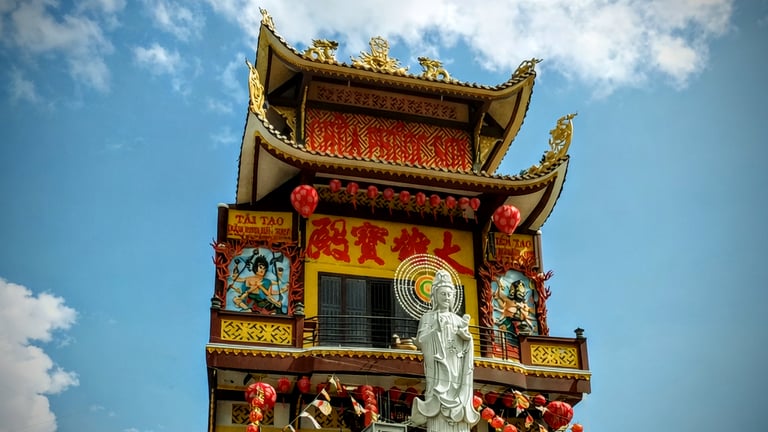
Chùa Phước Sơn. The pagoda by the river. It's not a government institution; it's a home held together by the neighborhood.
© 2025. All rights reserved.
hello@gonomadnest.com