
A Tiger on the Door: Finding "The Wild" in a Quiet Sóc Trăng Suburb
I found a paper tiger pasted on my bedroom door in Sóc Trăng. What looked like a sticker turned out to be a 300-year-old guardian spirit. Here is the story of Ông 30.
CULTURE
Hein Lombard
2/10/20264 min read
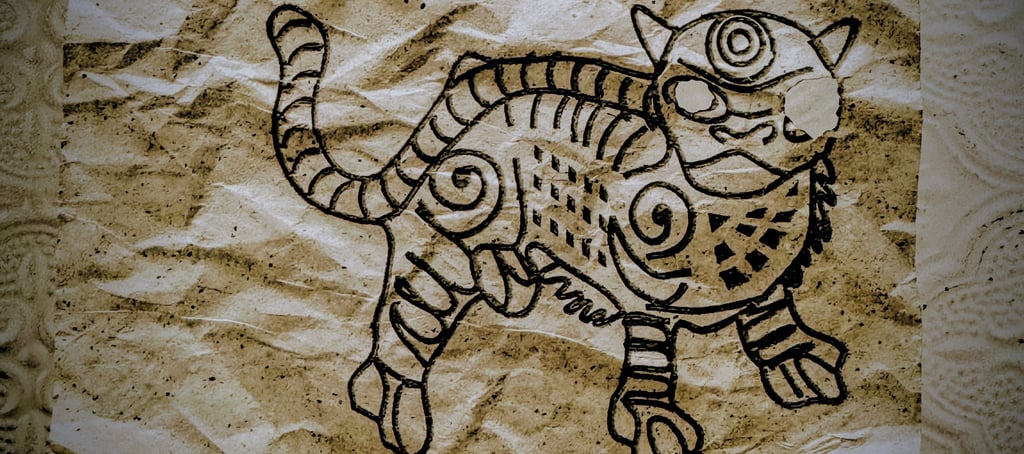
The Tiger on the Door
Two years ago, I moved into a house in KDC Sáng Quang, a quiet residential neighborhood about 1.2km from where I teach. It’s a world away from the noise of Trương Công Định street. Here, life moves at the speed of the older couples taking evening walks and young families chasing toddlers around the block.
The house itself felt lived-in. The built-in closet doors were covered in peeling cartoon stickers—clear evidence that a young family had lived there before me. But on the bedroom door, amidst the remnants of childhood play, there was something else.
Roughly pasted onto the glass panel was a hand-drawn image of a tiger.
It wasn't a cute cartoon tiger like Tigger or Hobbes. It was drawn in a fierce, folk-art style—bold lines, spiral patterns, and wide, staring eyes. To most expats, it might have looked like a piece of "trash" to be scraped off with the rest of the stickers. But something made me stop.
The Wood Tiger and the Bushveld
I’m a 1974 baby—a Wood Tiger in the Chinese Zodiac. Maybe that’s why I felt an immediate, unexplained kinship with this little paper beast. I decided to leave him there.
But there was another reason, one rooted deeper in where I come from.
Growing up in South Africa, you learn early on that the "King of the Beasts" isn't just a Disney character. We have a healthy, primal respect for the wild. You respect the Lion and the Leopard not because they are beautiful, but because they are powerful, dangerous, and real. In the African bush, a fence isn't just a barrier; it's a boundary between the human world and the wild.
Staring at that tiger on my Vietnamese bedroom door, I felt a familiar energy. It was that same respect for the apex predator—just translated from a physical fence in the African bush to a spiritual shield in the Mekong Delta.
The Skeptic and the Scholar
For months, "Little Tiger" stayed on my door. I’d nod to him in the mornings, my silent roommate. Eventually, curiosity got the better of me. I snapped a photo and sent it to my friend Thanh.
My friend Thanh, is my go-to guy for everything in Vietnam, but he’s also very modern. He brushed it off initially. "Just superstition," he said. "Old people stuff."
I was a little disappointed. I was hoping for a legend, but I got "superstition." But Thanh, being Thanh, didn't leave it there. A few hours later, he sent me a link to an article from Lao Động newspaper titled "Ông 30 in the Cultural Life of the Mekong Delta."
That article changed everything.
The "Wild West" of the Mekong
It turns out, my little tiger wasn't just decoration. He was a guardian.
I learned that in the Mekong Delta, when a child turns one (the Thôi Nôi ceremony), parents often paste a tiger image on the door of the room where the baby sleeps. It’s a ritual to ward off "heavy spirits" and ensure the child grows up strong and resilient. The cartoon stickers on the closet and the tiger on the door were part of the same story: parents doing everything they could to protect their child.
But why a tiger?
To understand that, you have to look at what this land used to be. Three hundred years ago, the Mekong Delta wasn't the peaceful grid of rice paddies and canals I cycle through today. It was a terrifying frontier—a dense, swampy jungle known as "Lâm tẩu."
When the first Vietnamese settlers arrived here during the Nam Tiến (the Great Southward Expansion), they weren't just fighting the elements; they were living next door to the real-life "Chúa Sơn Lâm" (Lord of the Mountains). Historical records describe the Delta as a place where "crocodiles swam in shoals like boat hulls, and tigers roamed in packs."
The settlers realized they couldn't fight nature into submission. So, they struck a spiritual deal. Instead of hunting the tiger (which was lethal), they worshipped it. They gave it respectful titles like "Ông 30" (Mr. Thirty) or "Hương Quản" (Village Guardian) to avoid summoning it by name.
It was a survival strategy: We respect your territory; you protect ours.
The Silent Guardian
That little paper sticker in Sang Quang was a faint, 300-year-old echo of that pact. The parents who lived there before me weren't just "superstitious." They were invoking an ancient guardian to watch over their sleeping child, just as their ancestors did in the wild swamps.
I eventually moved out of the house in Sang Quang. I left the built in closets with their fading cartoon stickers behind, but the tiger came with me.
I’m not a pioneer facing down a jungle cat, and I’m not a toddler needing spiritual protection. But as a Wood Tiger myself, living thousands of miles from the African bush I grew up in, I find comfort in him. He’s a reminder that whether you are in the savannas of South Africa or the wetlands of Vietnam, humans have always looked into the dark, seen glowing eyes, and decided to make peace with the wild, and the unknown.
He guards my new door now. Different house, same guardian.
Ông Hổ. Guardian spirit
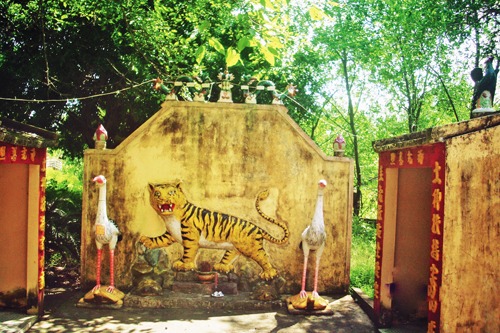
A typical outdoor shrine dedicated to 'Ông 30' (Lord Tiger) at the communal temple in Long Phu district, Soc Trang province, Mekong Delta. Locals often place offerings here to ask for protection." (Source:) https://baotintuc.vn/dan-toc-mien-nui/chuyen-tho-cop-o-nam-bo-20150304171916103.htm
© 2025. All rights reserved.
hello@gonomadnest.com