
Confessions of a Durian Lover: The Truth About Vietnam's Ri6 Durian
Vietnam's Ri6 Durian. Love it or hate it? My honest story of eating durian in Vietnam, why the local Ri6 variety is the true 'King,' and how this $3.3 billion fruit took over the Mekong Delta.
FOOD
Hein Lombard
1/29/20265 min read
It was 2018, and my agent, Phước, had his camera ready.
We were in between teaching location changes, and he had taken me out for Bún đậu mắm tôm. If you know Vietnamese cuisine, you know that mắm tôm (fermented shrimp paste) is the ultimate litmus test for foreigners. It’s pungent, purple, and aggressive. Phước lived for the moment I put it in my mouth; capturing my contorted facial expression was his favorite pastime. And I’ll admit, the photos were usually hilarious.
So, when he suggested we try Durian for dessert, I knew exactly what he was up to. He was looking for the sequel.
I was optimistically cautious. After all, the "King of Fruits" has a dubious reputation globally. It’s banned in hotels and airports for a reason. I braced myself for the smell, took a breath, and took a bite. Phước raised his camera, waiting for the gag reflex.
It never came.
Instead of disgust, I got custard. Rich, almondy, sweet custard. It was love at first bite. I looked at Phước, beaming with delight, and watched his face fall. He was genuinely disappointed that I wasn't suffering!
That was eight years ago. Today, living deep in the Mekong Delta in Sóc Trăng, I no longer need an agent to buy me fruit. In fact, I’ve become part of a much bigger obsession.
The Green Gold Rush
It turns out I’m not the only one addicted to this fruit. Since I took that first bite in 2018, the landscape of the Delta has completely transformed.
Rice is still the lifeblood of the Mekong—Vietnam is still a top global rice exporter—but these days, many rice farmers have diversified their harvests with endless rows of durian trees. In 2024 alone, Vietnam exported over $3.3 billion USD of durian—almost all of it heading north to China.
It’s actually becoming a serious rivalry. For decades, Thailand was the undisputed king, but Vietnam is catching up fast, now controlling over 40% of the market. So when you see those trucks thundering down Highway 1, they aren't just carrying fruit. They are carrying "Green Gold."
And living right in the middle of this boom means I have a front-row seat to the best harvest in the world.
The Hunt: Confessions of a Truffle Dog
The problem with being a durian lover in Sóc Trăng is that you can’t escape it. Riding my bicycle around town implies a certain level of freedom, but in reality, I am at the mercy of the wind.
My sense of smell has become my downfall. I can be halfway to a coffee shop, focused on the road, when the humid air shifts. Suddenly, I turn into a truffle dog. I literally sniff the air, adjusting my handlebars to follow the scent trail. If you can smell it from fifty meters away over the exhaust fumes of traffic, you know it’s ripe.
And once I find the stall, I don’t just buy the first fruit I see. In the Delta, you need a "Durian Man."
The Ritual: Choosing the King
Another side of Soc Trang's food culture.
While export markets often favor the Monthong (Dona) variety for its milder taste and paler flesh, here in the Mekong, we respect the Ri6. It is the undisputed King of the Delta.
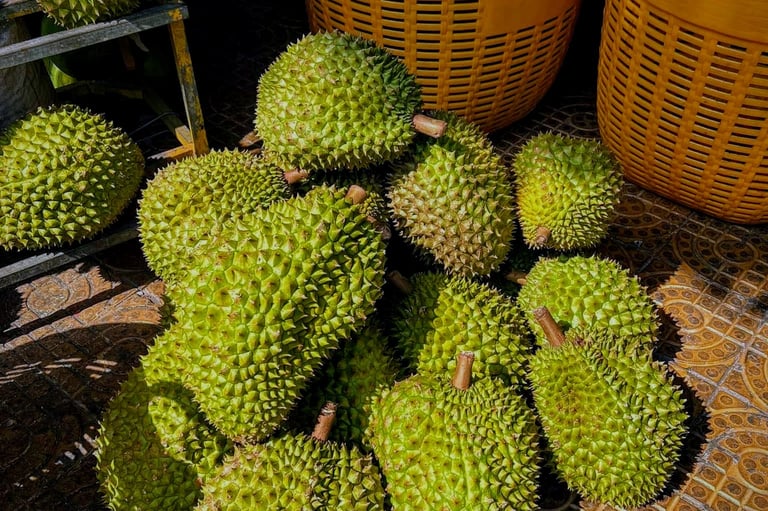
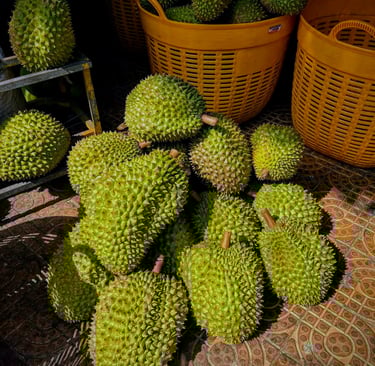
You can spot a Ri6 by its shape—usually pear-like with a narrow bottom and thick, sparse thorns. But the real secret isn't in how it looks; it's in how it sounds.
This is where the trust comes in. I watched my vendor recently—a guy whose yellow sandals ironically matched his product perfectly against the blue tarp. He picked up a 3kg fruit and tapped it with the flat of his knife.
Thud. Thud.
He shook his head and put it down. He was listening for a deep, muted sound that indicates the flesh has loosened slightly from the shell—a sign of perfect ripeness. A hollow, hard sound means it’s not ready. When he finally nodded and smiled, I knew we had a winner.
He sliced it open right there on the sidewalk. This is the "quality control" moment. The flesh was a vibrant, deep yellow—"dry" (meaning not mushy) and incredibly fatty.
"Not tasty?" he joked in Vietnamese, holding it up. We both knew he was lying. It was perfect.
The Spiky Passenger: Transporting the Goods
Getting a 3kg durian home on two wheels is a logistical puzzle that every expat in Vietnam eventually faces. I’ve learned the hard way: the most dangerous cargo in Vietnam isn’t glass or eggs—it’s a spiky football that wants to puncture your legs.
While a whole durian looks impressive strapped to the back of a bike, it’s a rookie mistake.
First, there is the safety hazard. Taking a sharp corner with a spiky projectile balancing on your rack is not for the faint of heart. But more importantly, there is the risk of heartbreak. There is nothing—absolutely nothing—more devastating than wrestling a durian home, sweating in the heat, only to crack it open and find the flesh is hard, pale, and inedible.
That is why I always have my "Durian Man" open it on the spot.
By getting it cut and boxed at the stall, I accomplish two things:
Quality Control: If he opens it and it's hard, I don't buy it. Simple. I only pay for the creamy, yellow perfection I can see.
Aerodynamics: A neat styrofoam box fits easily in a basket or a backpack. It’s safer for me, safer for the bike, and ready to eat the moment I walk through the door.
Hot Season, Hot Fruit: The "Heaty" Rule
Despite my love for it, durian isn't an everyday snack. In Vietnamese culture (and Traditional Chinese Medicine), durian is considered an extremely "heaty" food.
Eating it raises your body temperature. In the sweltering heat of the Mekong dry season (April and May), gorging on durian can literally make you feel feverish or give you a sore throat. It’s an indulgence, not a meal.
There is also the matter of seasonality.
Mekong Season: When the fruit is harvested right here in the Delta, it’s abundant, incredibly fresh, and reasonably priced.
The Off-Season: When the Delta harvest ends, the fruit often comes from Central Vietnam (the Highlands). Because it has to travel further, the price jumps significantly, and frankly, the freshness can be hit-or-miss compared to the local harvest.
The Antidote: The Queen of Fruits If you do indulge too much in the "King," local wisdom suggests you seek out the "Queen": Mangosteen.
You will often see purple mounds of mangosteen sold right next to the durian piles. This isn't a coincidence. Mangosteen is considered "cooling." Its sweet, tangy white flesh lowers your body temperature, balancing out the heat of the durian. It’s the perfect yin and yang of the fruit world—and a delicious excuse to buy both.
Conclusion: Don't Let the Smell Scare You Away
Durian is a divisive fruit. It splits rooms, ends marriages (allegedly), and gets banned from public transport. It demands a reaction. You will either love it with a fiery passion, or you will hate it with every fiber of your being. There is rarely a middle ground.
But that is exactly why you have to try it.
If I had let the smell stop me that day in 2018—if I had been too polite or too cautious to take that bite from Phước—I would have missed out on one of the great joys of living in Vietnam. I would have missed the thrill of the hunt, the banter with the vendors, and the simple pleasure of creamy, custard-like Ri6 on a Tuesday afternoon.
So, when you see those spiky piles on the side of the road in the Mekong, don't hold your breath and speed past. Stop the bike. Watch the vendor work. Trust the process.
Don't be afraid of the unknown. Sure, you might hate it. But take the risk anyway. You might just miss the chance of finding true love.
Durian Seller, Soc Trang fruit market. Quick visit to my new durian man with my teaching assistant, Miss Trâm
Ri6 Durian. Produce market, Soc Trang City, Vietnam
© 2025. All rights reserved.
hello@gonomadnest.com